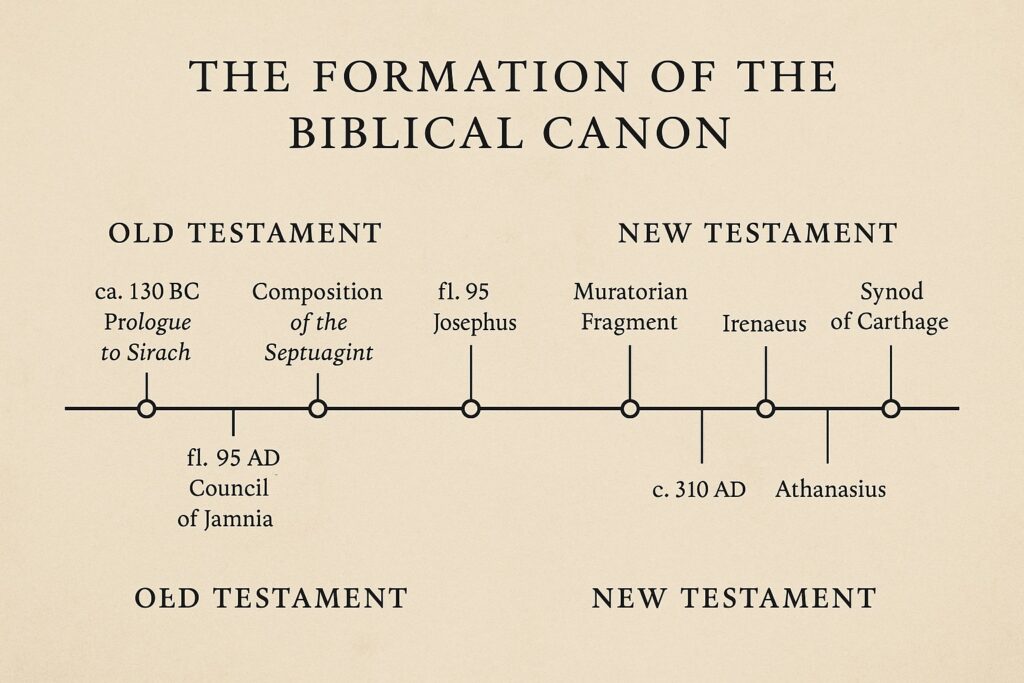
The Bible as we know it today is the result of centuries of prayerful discernment, scholarly study, and ecclesiastical debate. The canon—the set of texts regarded as Scripture—did not emerge overnight but developed gradually over time. This post outlines the historical timeline of the formation of the biblical canon and provides primary sources that give insight into the decisions behind the inclusion of specific books.
📜 Old Testament Canon Timeline
ca. 130 BC — Prologue to Sirach
The Prologue to Sirach (also called Ecclesiasticus) provides early evidence of an established group of sacred writings among the Jews. The author mentions “the law and the prophets and the others,” suggesting a threefold division of the Hebrew Scriptures.
Primary Source:
“Whereas many and great things have been delivered unto us by the law and the prophets, and by others that have followed their steps…”
— Prologue to Sirach (KJV)
3rd–2nd Century BC — Composition of the Septuagint
The Septuagint (LXX) was a Greek translation of the Hebrew Scriptures, including additional books not found in the later Hebrew canon. It became the primary version used by early Christians.
Overview:
Read more: Introduction to the Septuagint (LXX)
ca. 95 AD — Council of Jamnia (Yavne)
While not a formal council, Jewish scholars gathered in Jamnia likely confirmed the authority of the 24 books of the Hebrew Bible, which correspond to the 39 books in the Protestant Old Testament.
Primary Source:
Josephus, Against Apion 1.8
Read on Perseus Digital Library
✝️ New Testament Canon Timeline
ca. 95 AD — Josephus
Josephus’s writings indicate an awareness of a limited and closed Jewish canon, which influenced early Christian understanding of Scripture.
Primary Source:
Against Apion
Read online
ca. 170–200 AD — Muratorian Fragment
This early list of New Testament books, found in a Latin manuscript, shows that by the late 2nd century, many core New Testament writings (Gospels, Acts, Pauline Epistles) were widely accepted.
Primary Source:
ca. 180 AD — Irenaeus of Lyons
Irenaeus argued for the authority of the four Gospels and cited numerous New Testament writings as Scripture.
Primary Source:
Against Heresies Book 3
Full text
367 AD — Athanasius’s Festal Letter
In his Easter letter, Bishop Athanasius of Alexandria listed all 27 books of the current New Testament canon—this is the earliest exact match.
Primary Source:
Festal Letter 39
Read the English translation
397 AD — Council of Carthage
This regional council affirmed the 27 books of the New Testament as authoritative. The decision reflected consensus already developing in the broader Christian world.
Primary Source:
Canon XXIV of the Council of Carthage
Read here
1546 AD — Council of Trent
In response to the Protestant Reformation, the Roman Catholic Church formally canonized the books of both the Old and New Testaments, including the Deuterocanonical books, reaffirming the Septuagint’s influence.
Primary Source:
Decretum de Canonicis Scripturis
Read on the Vatican website (Latin)
🧠 Why These Books?
The main criteria for New Testament inclusion were:
- Apostolic Origin: Connected to an apostle or their close associate.
- Orthodox Teaching: Conformed to accepted Christian doctrine.
- Widespread Use: Read publicly in churches across diverse regions.
- Spiritual Value: Inspired and edifying in the worship life of the community.
The Old Testament canon varied by tradition:
- Hebrew/Jewish Canon: 24 books (eventually 39 in Protestant structure).
- Catholic Canon: Includes Deuterocanonical books found in the Septuagint.
- Orthodox Canon: Similar to Catholic but may include a few additional texts.
📚 Conclusion
The canon of Scripture was not arbitrarily assembled but emerged through historical events, spiritual discernment, and theological reflection. While different Christian traditions may recognize slightly different canons, the central message of God’s revelation remains unified.
📖 Sources & Links
- Prologue to Sirach (KJV)
- Introduction to the Septuagint (LXX) – Brenton Translation
- Josephus, Against Apion – Perseus Digital Library
- Muratorian Fragment – Early Church Texts
- Irenaeus, Against Heresies – New Advent
- Athanasius, Festal Letter 39 – New Advent
- Council of Carthage – Schaff’s Church Fathers
- Council of Trent Decrees – Vatican Website (Latin & English)